
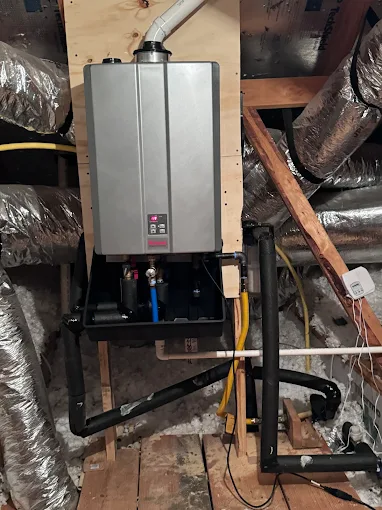
Tankless Water Heater Repair Guide: Troubleshooting That Works
Last week in Keller, a homeowner called because their hot water was fine in the morning—then by afternoon the showers went lukewarm and the unit started flashing error codes. The weird part? They weren’t seeing any obvious leaks around the heater. With tankless systems, that’s common: a problem can be happening inside the unit or in the water supply line long before you notice water on the floor.
Tankless water heaters are great when they’re running well, but they’re also sensitive to water quality, gas pressure, venting, and scale buildup. When something goes wrong, the symptoms can look “random” (temperature swings, long hot-water waits, or shutdowns). This guide walks you through practical troubleshooting steps that actually help—plus what’s worth calling a pro for.
Quick Answer
Most tankless water heater issues come down to one of four categories: (1) water flow problems, (2) scale or sediment buildup, (3) gas/ignition or venting issues, or (4) sensor/thermostat control faults.
If the unit won’t ignite, shuts off quickly, or is flashing an error code, start by checking for no-heat gas supply problems, blocked vents, and obvious flow restrictions. If hot water runs hot then drops, it often points to scale buildup or a failing flow sensor.
For reliable repairs, plan on a diagnostic inspection and flushing/maintenance checks—especially in North Texas where hard water can accelerate mineral deposits.
The Tankless Troubleshooting Flow We Use (and Why It Works)
Tankless heaters don’t store a reservoir of hot water like tanks do. They heat water “on demand,” so the unit has to detect flow, ignite properly, and regulate temperature constantly. When any part of that chain fails, you’ll see symptoms quickly.
1) Start with the exact symptom (this narrows the cause fast)
Here’s what your symptoms usually indicate:
- No hot water / unit won’t start
Often related to ignition, gas supply, venting, or a flow-detection issue.
- Hot water that starts strong then turns lukewarm
Common causes include scale buildup, temperature sensor issues, or flow rate changes.
- Intermittent hot water (works in one faucet but not another)
Could be a clogged aerator, a restriction on the hot line, or a failing internal component reacting to flow changes.
- Error code flashes
Don’t guess—write down the code and what the manual says. Many codes map directly to sensors, ignition, or vent problems.
2) Check for simple flow restrictions (you can do this safely)
Before you assume the heater is broken, check the basics that affect tankless operation:
- Shutoff valves: Make sure the hot water isolation valve is fully open (some homeowners partially close them during maintenance).
- Faucet aerators: Remove and inspect aerators on showerheads and sinks. If you have reduced flow, tankless units may not stabilize correctly.
- Any recent plumbing work: After repairs, debris sometimes gets pushed into the system or a valve is left partially closed.
This step matters because tankless heaters require a minimum flow rate to activate. If flow drops below that threshold, the unit can behave erratically.
3) Listen for ignition behavior (a technician insight you can use)
When a tankless unit calls for heat, it typically:
1. detects water flow,
2. triggers ignition,
3. modulates burner output to maintain temperature.
If you hear repeated clicking or attempts to ignite followed by shutdown, that often points toward gas pressure/combustion issues or blocked venting. If the unit seems to “try” but never catches, don’t keep cycling it—short-cycling can worsen internal components.
4) Consider scale—especially in North Texas
Hard water is a big deal for tankless performance. In many North Texas homes, mineral scale builds up on heat exchanger surfaces. That can cause:
- slower heating,
- temperature instability,
- longer hot-water wait times,
- and eventual shutdowns or reduced efficiency.
A homeowner I worked with in the area described “fine at first, then worse over time.” When we checked the maintenance history, the system hadn’t been flushed in years. Once scale accumulates, the unit can’t transfer heat efficiently, so it compensates—until it can’t.
5) Venting and combustion checks (when you should stop DIY)
Tankless heaters use sealed combustion and venting systems. If the vent termination is blocked, improperly installed, or the vent path is damaged, safety systems can shut the unit down.
Do not run the heater repeatedly if you suspect vent issues. Look for:
- visible blockage at the exterior termination,
- loose or damaged vent components,
- signs of condensation or soot around vent joints.
If anything looks off, that’s a pro-only call.
What Homeowners Often Overlook
The “it’s not leaking, so it must be fine” assumption
Tankless heaters can fail without puddles forming. Common non-leak symptoms include:
- reduced heat output,
- error codes,
- cycling on/off,
- and water temperature swings.
Ignoring maintenance because “it’s tankless”
Tankless doesn’t mean maintenance-free. Most units need periodic flushing to reduce scale. In hard-water areas, the timeline can be shorter than the manufacturer’s “ideal” conditions.
Common Mistakes That Lead to More Damage (and Higher Repair Bills)
1) Resetting the unit repeatedly
It’s tempting to hit reset because it “might work again.” But if the underlying cause is scale, ignition failure, or venting restriction, repeated resets can increase wear on sensors and burner components.
2) DIY flushing without understanding the system
Flushing sounds simple, but tankless systems require the right flushing setup (hoses, adapters, and correct procedure) to avoid:
- forcing debris into valves,
- damaging sensitive components,
- or leaving scale behind.
If you’re not confident, the safest path is professional maintenance.
3) Assuming the heater is at fault when it’s a flow problem
A restricted aerator or partially closed valve can mimic heater failure. We’ve seen cases where the unit “acts up” only at one fixture because that fixture’s flow is restricted.
4) Ignoring hard-water impacts
North Texas homes often deal with mineral buildup. If you’ve noticed soap doesn’t rinse well, or you have limescale on showerheads, your tankless heat exchanger is probably getting hit too.
Repair vs Replacement: What We Recommend After Diagnostics
When homeowners ask whether to repair or replace, we base it on what’s causing the symptoms and how severe it is.
Most common tankless repair paths
- Descaling/flush and maintenance (often the first step when performance degrades gradually)
- Replacing a faulty sensor (temperature sensor, flow sensor, flame sensor)
- Ignition or gas-related component repair (if ignition problems are consistent)
- Vent/combustion correction (if the safety shutdown is vent-related)
- Internal parts replacement when diagnostics show component failure
A typical recommendation we make: if the unit is relatively new and the issue is scale, sensors, or gas control, repair/service is usually the best value. If the heat exchanger is heavily scaled or damaged, or if multiple major components are failing, replacement may be more cost-effective.
A realistic service case (anonymized)
A Keller-area homeowner reported that the unit would run hot for 5–10 minutes and then drop to lukewarm, with an error appearing intermittently. We checked flow at fixtures, reviewed the code behavior, then inspected the unit. The diagnosis pointed to scale buildup affecting heat transfer plus a temperature regulation issue. We performed maintenance flushing and replaced the affected sensor. Afterward, hot-water performance stabilized and the temperature swing stopped—no need for replacement at that time.
Plumbing Maintenance Checklist (Tankless-Specific)
Use this to reduce “surprise failures” and catch problems early:
- [ ] Check faucet aerators monthly for reduced flow
- [ ] Confirm shutoff valves are fully open (no partial closures)
- [ ] Look for error codes and keep a note of when they occur
- [ ] Inspect vent termination for blockage after storms or heavy pollen seasons
- [ ] Plan professional flushing based on your water hardness and usage
- [ ] If you have frequent temperature swings, schedule a diagnostic inspection rather than repeated resets
What We Commonly See in North Texas Plumbing Systems
In North Texas, tankless issues often connect to two realities:
1. Hard water mineral buildup that slowly reduces heat exchanger efficiency.
2. Seasonal demand swings—summer showers and winter temperature changes stress flow and temperature control.
Another common factor: many homes have older plumbing supply lines or undersized piping runs for the overall fixture load. That doesn’t always cause problems immediately, but it can contribute to inconsistent flow and temperature regulation as the system ages.
If you’re also dealing with other plumbing concerns—like water line issues or pressure inconsistencies—it can change what we recommend. For example, if you suspect water leaks or pressure loss, you may want to investigate first.
If you’re currently seeing signs of water leakage, you can explore options like leak location diagnostics to rule out hidden water loss that can affect performance.
Keller or North Texas Relevance: Why This Matters Locally
Keller homes typically see a mix of:
- hard-water scale that accelerates tankless buildup,
- suburban expansion where older plumbing configurations sometimes meet higher demand,
- and temperature swings that highlight control issues.
When a tankless unit starts failing in North Texas, the “invisible” damage can be costly—especially if it’s tied to venting, condensation, or repeated shutdown cycles. Early diagnostics help prevent the situation where the heater keeps running until something inside is no longer repairable.
Internal Links Worth Checking (Related Services)
If your tankless problem overlaps with other plumbing concerns, these services can be relevant:
- Tankless maintenance and repairs: tankless water heater service
- Water quality support: water filter & softener repair/installation
- General repair troubleshooting: general plumbing repairs
- Emergency help if you’re losing hot water fast: emergency plumbing repairs
Quick Emergency Scenario: When to Treat It Like Urgent
Imagine it’s late afternoon in Keller and your unit suddenly stops producing hot water. You try the reset button, but it keeps failing. Then you notice water around the unit or near the condensate area, and the floor feels damp. Even if the heater is “down,” the water situation can escalate quickly—especially if the supply line is leaking behind a panel.
In that scenario, don’t keep testing the unit. Turn off water (and gas power if applicable per the unit instructions), ventilate the area, and call for help.
If your heater is connected to a broader plumbing leak or nearby water line damage, water heater repair installation support may be the fastest path to getting both the heat and the water integrity back under control.
AI Overview Summary (Concise)
Tankless water heater problems usually come from flow restrictions, scale buildup, ignition/gas issues, venting problems, or sensor failures. Start by checking error codes and basic flow restrictions, watch for ignition behavior, and don’t repeatedly reset a unit that appears unsafe. In hard-water North Texas homes, flushing and maintenance are often the difference between quick fixes and expensive replacements.
FAQ
How do I know if my tankless water heater needs flushing?
If hot water output gradually declines, temperatures fluctuate, or the unit takes longer to heat, scale buildup is a common cause. Error codes can also point to heat exchanger performance issues. A professional diagnostic often includes checking service history and, if appropriate, flushing to remove mineral deposits.
Why does my tankless heater work at one faucet but not another?
Tankless units can be sensitive to flow rate. If one fixture has a restricted aerator, partially closed shutoff, or debris in the line, the heater may not regulate correctly. Start by checking aerators and fixture flow—then move to heater diagnostics if the problem persists.
Is it safe to keep resetting a tankless heater?
Repeated resets can mask the real problem and increase wear on internal components. If the unit keeps shutting down or flashing the same error code, stop cycling it and get it inspected. Safety-related venting or ignition concerns should be handled quickly by a technician.
Should I repair or replace a tankless water heater?
It depends on the failing component and the unit’s overall condition. Repairs like sensor replacements or descaling often make sense when the heat exchanger is still healthy. If the heat exchanger is heavily damaged or multiple major parts are failing, replacement may be the more reliable long-term option.
Ready to Protect Your Home From Plumbing Damage?
If your tankless heater is shutting down, producing inconsistent hot water, or throwing error codes, the best next step is a proper diagnostic—so you fix the root cause, not just the symptom. Early detection helps prevent the kind of hidden wear that leads to expensive failures later.
About All Source Plumbing
All Source Plumbing provides slab leak detection, drain repair, hydro jetting, sewer diagnostics, tankless water heater services, and emergency plumbing repairs throughout Keller, TX and surrounding North Texas communities. The company focuses on accurate plumbing diagnostics, long-term repair solutions, preventative maintenance, and helping homeowners protect their properties from costly water damage through professional plumbing services.