
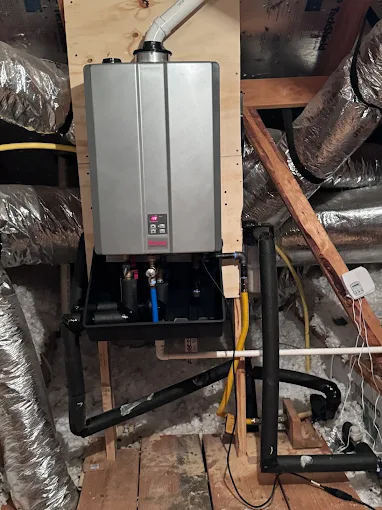
Tankless Water Heater Repair: Restoring Hot Water Flow
It’s usually the quiet warning that gets a tankless water heater first. You’ll be halfway through a shower in Keller, Texas, and the water suddenly turns cooler—then it comes back for a minute, then drops again. Or you notice the hot water is there, but it’s weaker, like the heater is “thinking” instead of heating.
In North Texas homes, that kind of inconsistent hot water often points to a repair issue—not a “normal” tankless behavior. When tankless units don’t get what they need (gas, water flow, or clear venting), they can protect themselves by limiting output. The result is frustrating for homeowners and, if ignored, can lead to costly scale buildup or component failure.
Quick Answer
If your tankless water heater won’t maintain hot water, the most common causes are restricted flow (dirty filters/scale), venting or combustion issues, or sensors/ignition problems. A proper diagnosis checks gas supply, inlet water temperature, error codes, flow rate, venting condition, and internal scale. In many cases, cleaning and replacing worn parts restores performance; in others, replacement is more cost-effective—especially if the unit is older or heavily scaled.
What We Commonly See in North Texas: Tankless Service Breakdowns
From the field, the pattern is consistent: homeowners call after hot water becomes unreliable, but the real problem started earlier. A tankless system is demand-driven, so it’s more sensitive to changes in flow and combustion than many tank-style heaters.
Here are the most frequent issues we encounter:
1) Scale and mineral buildup (hard water + heat = trouble)
North Texas water can be mineral-heavy. Over time, those minerals deposit on heat exchanger surfaces. When that happens, the unit can still fire, but it struggles to transfer heat efficiently. Homeowners often describe it as:
- hot water “not as hot as it used to be”
- water temperature swings during showers
- long warm-up times at faucets
A technician’s observation we make often: even when there’s no dramatic error code, you can sometimes see the performance drop as the heater struggles to reach setpoint temperature under flow.
2) Restricted water flow (filters, strainers, or partially clogged inlet screens)
Tankless units regulate output based on flow rate. If the incoming flow is restricted—by a clogged inlet filter or sediment in the system—the heater may not engage properly, or it may cycle.
3) Venting and combustion air problems
Tankless water heaters are designed to vent combustion gases safely. If the vent is blocked, improperly configured, or degraded, the unit may:
- shut down intermittently
- run less efficiently
- throw safety-related errors
This is one of those situations where “it kind of works” can still be a warning sign.
4) Ignition or flame sensing issues
If ignition is inconsistent, the unit may attempt to start, fail, then retry—leading to temperature dips mid-use.
5) Temperature sensors and control board faults
Sensors can drift out of calibration. Then the unit may misread conditions and reduce output to stay safe.
Signs You May Have a Hidden Tankless Problem
Not every issue is obvious. These clues often show up before a full failure:
- Hot water is inconsistent across fixtures (one shower is worse than a kitchen sink)
- The unit fires but doesn’t sustain output
- Error codes appear only after certain usage patterns (showers vs. dishwashing)
- Increased cycling sounds—more frequent on/off than normal
- Water pressure feels normal, but hot water performance doesn’t match demand
A Real Home Emergency We Respond to: “The Shower Turned Cold—Then the Floor Got Wet”
One recent call involved a homeowner who reported erratic hot water during evenings. They assumed it was “a tankless quirk” and waited for it to worsen. By the time we arrived, the unit had developed a leak at or near plumbing connections from thermal cycling and age-related wear.
Here’s what made it urgent: the leak was small enough to seem manageable until it ran longer during peak household use. Then moisture accumulated around the unit area and nearby floor transitions. In Texas homes with slab foundations and concrete floors, water can travel along the path of least resistance—meaning the visible wet spot isn’t always where the water started.
The fix required both repair work and a system check to ensure the heater would operate safely afterward. That’s why tankless repair isn’t just about hot water—it’s also about preventing secondary damage.
Our Experience Diagnosing Tankless Repairs in Texas Homes
In the field, we follow a methodical process rather than jumping straight to parts replacement. On tankless systems, the same symptom can be caused by different root problems, and “guessing” wastes money.
A firsthand technician observation: when we see temperature swings, we don’t just look at the heater. We also check for upstream flow issues and confirm whether the heater is actually reaching and maintaining setpoint under real demand. Sometimes the heater is fine internally, but the house plumbing is restricting flow or the supply is fluctuating.
A proper diagnostic typically includes:
- reviewing error codes (if present)
- checking inlet water temperature and flow behavior during demand
- inspecting filters/strainers and verifying flow rate meets minimum requirements
- evaluating venting and combustion conditions
- testing ignition/flame detection and sensor readings
- assessing likely scale impact based on age, usage pattern, and performance symptoms
If scale is suspected, cleaning can be the most effective first step—provided the heat exchanger condition is still repairable.
Common Mistakes That Lead to Expensive Tankless Problems
Mistake #1: Ignoring inconsistent hot water “because it still heats”
Tankless units often fail gradually. Homeowners may wait until the unit stops completely. By then, scale and component wear can accelerate.
Mistake #2: Using chemical flushes without confirming the cause
DIY flushing can help in some cases, but if the underlying issue is venting, ignition, or sensor control, flushing won’t fix it. Worse, repeated flushing with the wrong approach can add stress to components.
Mistake #3: Overlooking hard water and skipping maintenance
If you have a tankless heater, scale management isn’t optional. A good maintenance routine can prevent many “mystery” performance declines.
Mistake #4: Assuming “water pressure problems” are separate from tankless issues
Tankless performance is tightly linked to flow rate. When flow is restricted—even slightly—the heater can behave unpredictably.
Repair vs. Replacement: What Makes Sense for Homeowners
When homeowners ask whether to repair or replace, the answer depends on the cause, the unit’s condition, and how severe the buildup or component wear is.
Here’s a realistic decision framework:
Repair is often the better choice when:
- the issue is limited to sensors, ignition components, or a vent-related fix
- scale buildup is manageable and the heat exchanger is still in good shape
- the unit is relatively newer and has been maintained
- performance issues improve after cleaning and verified adjustments
Replacement becomes the smarter move when:
- the heat exchanger is heavily scaled or damaged
- multiple components have failed in a short window
- the unit is older and repairs keep bringing diminishing returns
- venting or setup issues require extensive rework and the heater’s condition is uncertain
Quick reference table (typical scenarios)
| Symptom | Likely cause | Typical recommendation |
|---|---|---|
| Hot water temp drops mid-shower | scale, flow restriction, sensor issue | diagnose first; clean and repair as needed |
| Unit fires inconsistently | ignition/flame sensing, flow minimum not met | test ignition/sensors; verify flow |
| Error code related to combustion/venting | vent restriction or combustion air problem | vent inspection + correction |
| Hot water is lukewarm at all times | heavy scale reducing heat transfer | flush/clean; assess exchanger condition |
For a related service that often comes up alongside tankless performance issues, we also handle tankless water heater repair and installation so homeowners can get both diagnosis and the right restoration work done without guessing.
Tankless Service Recommendations and a Practical Maintenance Checklist
If your heater is acting up, the best next step is a professional inspection. But you can also reduce the odds of repeat problems with a simple upkeep plan.
Plumbing Maintenance Checklist (Tankless-Focused)
- Schedule tankless maintenance: follow the manufacturer guidance and local water conditions.
- Check inlet filters/strainers: debris and sediment can restrict flow.
- Plan for scale management: especially in homes with mineral-heavy water.
- Watch for venting issues: keep vent terminations clear of obstructions.
- Monitor performance changes: temperature swings and cycling are early warnings.
- Flush only if appropriate: confirm whether flushing is the right fix for your symptoms.
When homeowners should take immediate action
If you notice persistent error codes, unusual burner behavior, or repeated shutdowns, don’t keep trying to “push through.” That’s when a full tankless evaluation is the safest approach.
Keller and North Texas Relevance: Why This Gets Worse Here
Keller homes often experience a combination of factors that accelerate tankless wear:
- hard water and mineral buildup
- seasonal temperature swings that increase heating demand
- aging supply plumbing in some neighborhoods
- high summer usage when multiple fixtures run at once
In practice, we see more tankless performance complaints during the hot months because demand is higher. If the unit is already scaled or flow-restricted, it shows up first when the household needs hot water most.
A Realistic Anonymized Case: Restoring Hot Water Without Replacing the Heater
A common scenario we see: a family in North Texas reported that their tankless unit delivered strong hot water for the first few minutes, then the temperature dropped during extended showers. No major leak was present, but the heater’s output was inconsistent.
After diagnosis, the technician found signs of scale buildup affecting heat transfer, plus a flow restriction tied to a partially clogged inlet strainer. The repair plan was:
1) clean and service the internal components as needed (including scale removal)
2) address the flow restriction
3) verify performance under real-use demand
Result: hot water stabilized, temperature swings reduced, and the unit returned to expected operation without replacement. The key was diagnosing the cause instead of replacing based on symptoms alone.
References (Grounding the Approach)
- The U.S. Department of Energy notes that hot water performance and efficiency depend heavily on how systems are maintained and operated efficiently.
- Energy Star guidance emphasizes that proper installation, maintenance, and correct sizing matter for heating system performance over time.
- Industry guidance from tankless manufacturers commonly recommends periodic maintenance/descaling in areas with hard water to maintain heat exchanger efficiency.
- General plumbing maintenance research consistently shows that scale buildup reduces heat transfer and increases operating stress on heating equipment.
(If you’d like, we can share the specific manufacturer maintenance recommendations that match your heater model during service.)
FAQ
How do I know if my tankless water heater needs repair or replacement?
Start with symptoms: inconsistent temperature, repeated cycling, or error codes usually warrant diagnostics. Repair is more likely if the issue is limited to ignition, sensors, venting, or moderately scaled components. Replacement becomes more realistic when the heat exchanger is heavily damaged or multiple parts fail repeatedly.
What’s the most common reason for lukewarm hot water on a tankless unit?
Hard water scale buildup is one of the most common causes in North Texas. It reduces heat transfer efficiency, so the heater may fire but can’t maintain temperature under normal flow.
Can a clogged drain or sewer issue affect my tankless heater?
Usually they’re separate systems. However, plumbing problems like leaks, pressure fluctuations, or whole-house flow restrictions can affect how a tankless unit performs. If you’re seeing both drainage issues and hot water problems, it’s worth diagnosing both rather than guessing.
Is it safe to flush my tankless water heater myself?
It can be, but only if you’re using the correct method and you’re sure flushing addresses the root cause. If the problem is venting, ignition, or sensor faults, flushing won’t fix it—and repeated DIY attempts can delay the right repair.
Ready to Protect Your Home From Plumbing Damage?
If your tankless heater is struggling to keep hot water steady, the most cost-effective path is early diagnostics—before scale, cycling, or small leaks turn into larger repairs. All Source Plumbing can restore reliable hot water flow with careful troubleshooting and the right repair or service plan.
About All Source Plumbing
All Source Plumbing provides slab leak detection, drain repair, hydro jetting, sewer diagnostics, tankless water heater services, and emergency plumbing repairs throughout Keller, TX and surrounding North Texas communities. The company focuses on accurate plumbing diagnostics, long-term repair solutions, preventative maintenance, and helping homeowners protect their properties from costly water damage through professional plumbing services.