
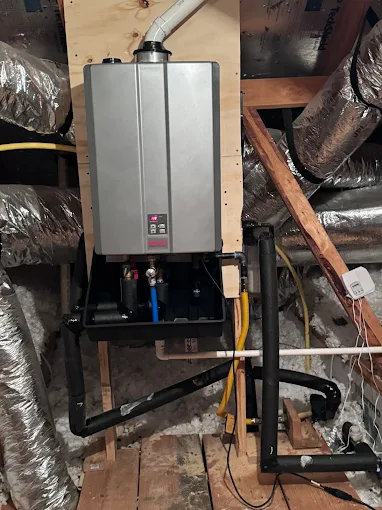
Tankless Water Heater Repair: No Hot Water Diagnosis
The call we hear most often in Keller is simple: “My shower is cold, but the rest of the house seems fine.” With a tankless water heater, that symptom can look straightforward—until you start troubleshooting. In North Texas homes, where summer water demand spikes and hard water is common, a “no hot water” situation is often caused by something specific (and fixable), not a total heater failure.
One homeowner told us their unit would fire for a second—then shut down. Another noticed the hot water was inconsistent: a few seconds of lukewarm flow, then nothing. In both cases, the problem wasn’t “no hot water” in the general sense. It was a diagnostic failure in the heater’s ability to sense flow, heat, and vent safely.
Below is the same kind of no-hot-water diagnosis process our technicians use—so you can understand what’s happening and what to check before you assume the unit needs replacement.
Quick Answer
If your tankless water heater has no hot water, the most common causes are:
- Insufficient water flow (clogged inlet filter, scale buildup, restricted plumbing line, or failing flow sensor)
- Ignition or burner issues (gas supply problem, blocked combustion air/vent, or faulty ignition components)
- Temperature sensor/thermistor problems (heater can’t confirm correct temperatures)
- Hard water scale or lime buildup (especially common in North Texas)
- Vent/air intake restrictions (safety shutdown can stop hot water even if the unit “tries” to run)
A proper diagnosis checks flow, gas/ignition, venting, and sensor readings—not just the thermostat setting.
When “No Hot Water” Happens: The Technician’s Diagnostic Path
Tankless units are designed to heat only when they detect active hot water demand. That means “no hot water” usually falls into one of two categories:
1. The unit never starts (no ignition, no flame, no heating cycle)
2. The unit starts but can’t sustain safe heating (fires briefly, then shuts down)
Step 1: Confirm the problem is actually the water heater (not a single fixture)
- Try hot water at two locations (example: a kitchen sink and a shower).
- If hot water is missing everywhere, focus on the heater, isolation valves, or whole-system flow/pressure.
- If it’s only missing at one fixture, you may have a stuck aerator, cartridge issue, or localized restriction.
Step 2: Check for “unit response” indicators
A tankless heater typically shows some combination of:
- an LED or error code
- a display message
- a brief burner attempt
- a fan/combustion cycle
Firsthand observation: On many no-hot-water calls, homeowners report “it used to work and now it doesn’t,” but the unit is still doing something—like attempting ignition for a few seconds. That short cycle often points to vent restriction, gas pressure/ignition failure, or a flow/scale issue that prevents stable heating.
Step 3: Determine whether flow is the culprit
Tankless heaters require a minimum flow rate to turn on. If the unit can’t detect enough flow, it may not ignite—or it may shut down to protect itself.
Common causes include:
- clogged inlet screen/filter
- mineral scale restricting internal passages
- shutoff valves partially closed
- plumbing restrictions in the hot water line
Residential clue: If the heater starts at full demand but fails when you reduce flow (like switching to a low-flow shower head), it can indicate a flow-sensing or scale-related restriction.
Step 4: Check scale and hard water impact (North Texas reality)
North Texas water can be hard enough to accelerate mineral buildup. Over time, scale forms where water passes through heat exchanger surfaces. That buildup can:
- reduce heat transfer efficiency
- increase temperature readings beyond what the unit can manage
- trigger shutdowns that look like “no hot water”
If you’ve never had a tankless flush or you’re unsure, scale becomes a top suspect—especially with symptoms that began gradually.
What Homeowners Often Overlook (Common Mistakes)
Mistake #1: Turning the temperature up and assuming it’s “fixed”
Higher settings don’t solve scale, flow restrictions, or vent problems. They can even make shutdowns more frequent if temperature control is already struggling.
Mistake #2: Resetting the unit repeatedly
Resetting can clear a lockout for a short time, but if the underlying issue is vent blockage or an error-trigger condition, the heater may fail again quickly. We often see this after a homeowner tries multiple resets over a day.
Mistake #3: Ignoring venting and combustion air changes
A vent termination can get blocked by:
- debris
- insect nesting
- misaligned vent components after maintenance or remodeling
- dampness or soot buildup in certain conditions
Even a small obstruction can cause the safety system to stop heating.
Mistake #4: Assuming “it’s definitely broken”
Tankless heaters are sensitive devices. “No hot water” is frequently caused by a fixable restriction (like a clogged filter or scale). Replacement becomes the right answer only after diagnostics show the heat exchanger or critical components can’t be restored.
Repair vs Replacement: What We Recommend After Diagnosis
Here’s how we typically decide what to do once we’ve confirmed the cause.
Most common “no hot water” repairs
- Tankless water heater maintenance / descaling flush if scale is restricting flow or heating
- Inlet filter cleaning if flow is insufficient
- Gas/ignition troubleshooting (including checking combustion behavior and gas supply stability)
- Sensor replacement if thermistor/temperature sensing is out of range
- Vent/air intake corrections if the system can’t vent properly
When replacement becomes more likely
Replacement discussions usually happen when:
- the heat exchanger is heavily damaged
- repeated shutdowns persist despite cleaning and component replacement
- internal failures make repairs inefficient compared to a new unit
- the unit is well beyond its typical service life and repairs keep coming back
Repair recommendation (practical next step)
If you have no hot water, the safest and most cost-effective path is:
1. Verify hot water demand at multiple fixtures
2. Check for error codes / burner behavior
3. Inspect for obvious valve/flow issues
4. Have a technician perform flow + combustion/vent + temperature/sensor diagnostics
5. If scale is suspected, perform proper flushing and testing before declaring the heater dead
If you’d like a deeper look at what’s involved when tankless problems are diagnosed and handled, you can review our service page for tankless water heater repair and installation for the typical repair workflow.
A Realistic Service Case (Anonymized)
A homeowner in a North Texas suburb called because their tankless heater would ignite but never deliver sustained hot water. The unit display showed a shutdown pattern rather than a straightforward “failure.”
Our technician checked:
- hot water flow at the fixtures
- inlet filter condition
- vent/combustion air pathway for restriction
- temperature readings during the attempted ignition cycle
Findings:
- the inlet filter had mineral buildup
- the system showed signs of early scale affecting heat transfer stability
- the heater was shutting down after briefly attempting to maintain safe temperatures
Repair outcome:
- inlet cleaning and a proper descaling flush
- follow-up testing to confirm stable heating behavior under normal shower demand
What could have been a costly replacement became a repair and maintenance solution—because the diagnosis matched the symptom pattern instead of guessing.
Plumbing Prevention & Maintenance Checklist (Tankless-Focused)
- [ ] Confirm all hot water isolation valves are fully open (especially after plumbing work)
- [ ] Check for error codes or blinking status lights and record what they show
- [ ] Inspect the vent termination area for debris/insects (don’t block airflow)
- [ ] Replace clogged shower/aerator screens as needed (a restricted fixture can mimic heater issues)
- [ ] Schedule periodic tankless maintenance/flush based on your water conditions and usage
- [ ] If you notice reduced hot water performance, address it early—scale rarely “fixes itself”
- [ ] After any remodeling, verify venting clearances and re-check system performance
If you’re concerned about water quality contributing to scale, a related option is water filter and softener repair or installation to help extend tankless service life.
Keller and North Texas Relevance: Why This Shows Up Here
Tankless heaters in Keller often face two local realities:
1. Hard water buildup
Mineral scale can accumulate faster than homeowners expect, especially in high-demand households.
2. Seasonal demand changes
When summer heat drives higher usage (more showers, longer laundry cycles, outdoor cleaning), even small restrictions in flow or internal heating can show up quickly.
One more local factor we see in North Texas: homes with older plumbing layouts or transitions (like long hot water runs) can create conditions where tankless units must work at the edge of their flow thresholds—making maintenance and proper diagnostics even more critical.
Quick “Signs You May Have a Hidden Problem” (Before It’s a Full No-Hot-Water Event)
If you’re not at “no hot water” yet, these are warning signs:
- hot water starts strong, then fades during the same shower
- burner ignites inconsistently
- temperature swings (lukewarm, then hot, then cold)
- long hot water wait times followed by weak output
- repeated shutdowns or error messages after normal usage
These signs often align with early scale, sensor drift, or flow restrictions—problems that are much cheaper to address before they reach full shutdown.
FAQ
Why does my tankless heater start but I still get no hot water?
If the unit ignites briefly and then shuts down, it often indicates a safety-related condition. Common causes include insufficient flow, restricted inlet filtration, temperature sensor issues, or vent/combustion air restrictions. A technician should check flow rates, error codes, venting, and temperature readings rather than only adjusting the temperature setting.
Could a clogged shower head or faucet cause “no hot water” on a tankless?
It can—especially if the fixture restriction reduces flow below the heater’s activation threshold. However, if you’re seeing no hot water at multiple fixtures, the issue is more likely at the heater or whole-house hot water plumbing (like a clogged filter, scale buildup, or a shutoff valve not fully open).
Is tankless flushing something I can DIY?
Home flushing is sometimes attempted, but it’s easy to miss the signs of scale severity or to use the wrong procedure/chemistry for your unit. A proper maintenance service includes testing before and after to confirm performance. If you’re repeatedly seeing shutdowns, you’ll want a professional diagnostic rather than repeated DIY resets.
What’s the fastest way to get my hot water back safely?
The fastest safe path is identifying whether the unit is error-locking, whether venting is obstructed, and whether flow is restricted. If the heater is showing error codes, don’t ignore them—share the code with your technician so they can start with the most likely causes.
Ready to Protect Your Home From Plumbing Damage?
No hot water is more than an inconvenience—when tankless issues lead to repeated shutdowns, homeowners sometimes delay diagnostics while small restrictions worsen. Early troubleshooting protects your system and helps you avoid bigger plumbing repair problems down the road.
About All Source Plumbing
All Source Plumbing provides tankless water heater repair and service, maintenance, and water heating diagnostics throughout Keller, TX and surrounding North Texas communities. We focus on accurate troubleshooting, long-term repair solutions, and practical homeowner education—so you can restore hot water safely and protect your home from preventable water damage and costly system failures.